

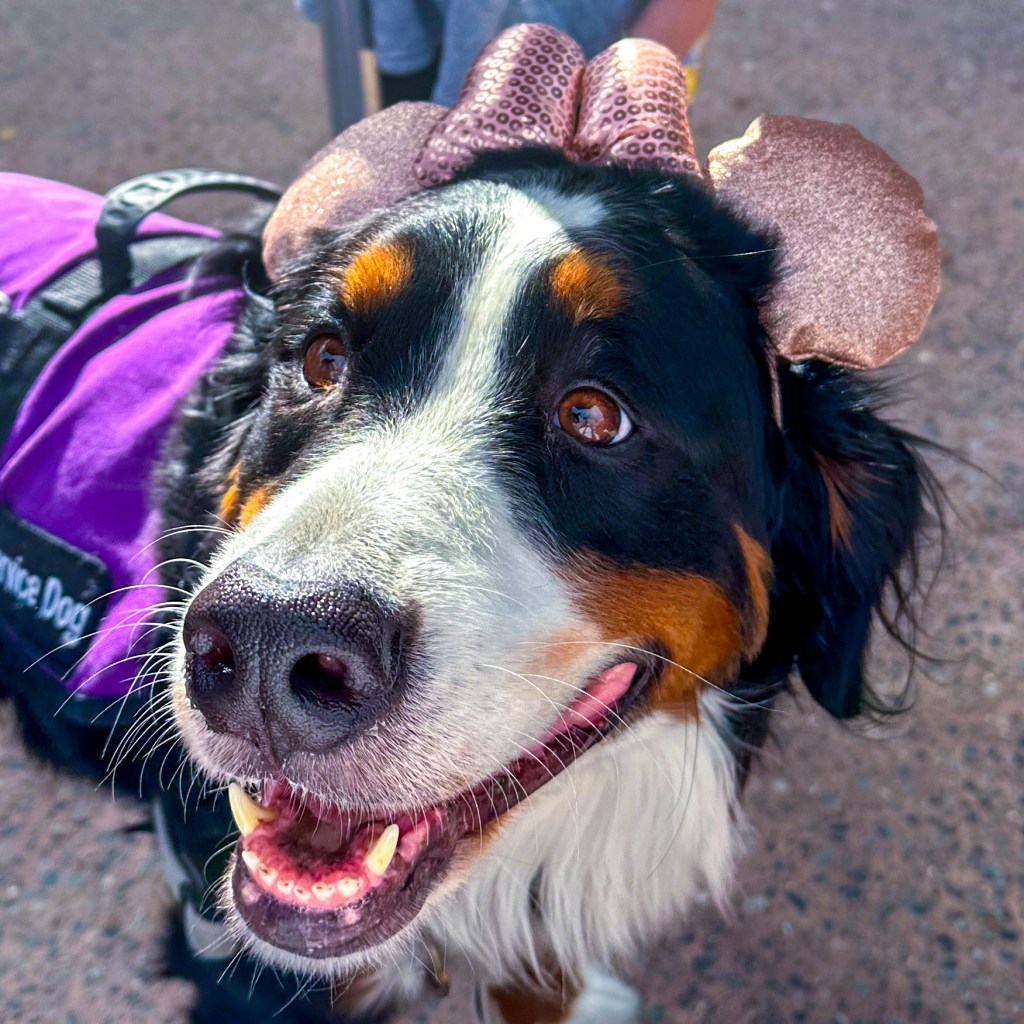
I had just walked into my son’s doctor’s office and was standing at the desk checking him in. Suddenly, from the far side of the room, a large teenager came charging toward us. It was reasonably obvious that his mental capacity was not as mature as the large frame would imply as he screamed “Doggie!” at the top of his lungs and swooped in to give my service dog, Mouse, a very big hug. The boy’s mother came after him and pulled him away from the object of his attraction.
On a different occasion, I encountered a “service dog” team where the dog was wearing a box muzzle. The multi-day training course involved moving around and acting out emergency search and rescue situations; the handler was an instructor. On more than one occasion, that muzzle saved the hide of my service dog when we got too close.
Frankly, this dog should not have been working as a service dog. Dogs with a history of aggression are not protected by the ADA because they can pose a danger to the public (I have on more than one occasion seen a dog remove their muzzle). In addition, this shows that the dog’s training, in general, has been severely lacking and it will damage the reputation of other service dog teams.
While incidents such as this are the most extreme that I have encountered, so far, it highlights a necessary aspect of service dog training. There are only so many options that a leashed dog has when startled and feels their space has been invaded. If not trained to handle something like this, undesirable behaviors can occur from something as simple as wetting themselves, to growling, or even biting.
Service dogs have become more commonplace in the US, but it is still a daily occurrence to encounter exclamations from nearby, “Doggie!”, “Why is a dog here?”, “Is that a dog?” (No, it’s a hippopotamus), or simply fascinated staring from a distance. Every team I have met has regularly encountered what I refer to as ‘drive-by petting’, where someone will reach out as they are passing you (attempting to not be noticed) to pet the dog.
Being touched by a stranger with no warning is very disturbing for your dog. Imagine if I came up behind you at the grocery checkout and started running my fingers through your hair; choice words would likely be exchanged, and I may even get punched.
I have known potential service dogs that have had to be ‘washed’ (failed) because they were unable to handle this.
Expose your dog early to as many new experiences as you can. Here are several suggestions:
- Ask friends or family to run up to your dog like an excited, high-energy child. Encourage them to jump up and down, scream, screech, and yell ‘Doggie’
- Ask them to wear different types of clothing including hats, masks and sunglasses (and the combination of those items).
- It also doesn’t hurt to have your dog wear different items.

- Get someone to carry a cane, push a walker, or ride in a wheelchair.
- This may seem like an odd comment, but ensure that your dog is exposed to a wide variety of different races.
- Find a fog machine and/or bubble machine.


- Reproduce noises such as sirens, drums, beeping, bangs, and pops.
- Visit playgrounds and allow the children to give your dog treats. (While it seems to me that children are actually more likely to ask you if they can pet your dog than many adults, you WILL encounter a LOT of children during your dog’s career.)
- Walk past statues of all types, particularly ones that portray humans and/or animals.
- Check out the toy department. I once had my previous service dog bark at a 5-foot tall teddy bear.
- Stop by your local firehouse and police station. If they are not busy, someone is usually willing to dress in their gear and pass out treats.
(You never know when they might need to enter your home unexpectedly.)
While you obviously cannot anticipate and train for every encounter, the more experiences your dog is familiar with the less likely they are to see something new as a threat. It’s crucial to expose your service dog to various environments, people, animals, sounds, and objects from an early age to help them become well-adjusted and confident. Socialization plays a pivotal role in shaping a dog’s behavior and can contribute to reducing fear and anxiety in unfamiliar situations. By gradually introducing them to different stimuli in a positive and controlled manner, you can build their trust and resilience, ultimately fostering a well-rounded and adaptable companion for various life situations.
Please subscribe to my blog for more information about service dogs and central Florida.
Also, please check out my shop, Mouse’s Dog Gear, for handmade collars and leashes!

 Welcome to Mouse’s Dog Gear, We’ll be Exploring Florida with my Service Dog Mouse.